How Indian Small Businesses Can Start Exporting Products Internationally
India is home to thousands of small businesses producing products that have demand in markets around the world.
From Indian suits and ethnic wear to handicrafts, garments, footwear, accessories, home products and manufactured goods, small businesses have many opportunities to reach international customers.
But for a business that has never exported before, the process can seem complicated.
Where do you find international customers?
What documents are required?
How should products be packed?
How do you send the shipment overseas?
What happens at customs?
The good news is that you don't have to become a large company before you start exploring international markets.
With proper planning, documentation and the right logistics partner, a small Indian business can gradually build an international customer base.
1. Choose the Right Product
The first step is identifying a product that can be sold internationally.
Indian businesses have opportunities in many categories, including:
- Indian ethnic wear
- Suits and dresses
- Garments
- Handicrafts
- Home décor
- Jewellery and accessories
- Footwear
- Textiles
- Fashion products
- Manufactured products
- Product samples
Before starting, research whether your product is suitable for your target country's import requirements.
2. Identify Your Target International Market
Don't try to sell everywhere at once.
Start by selecting a few countries where you believe there is demand for your product.
For example:
🇺🇸 USA
🇨🇦 Canada
🇬🇧 UK
🇦🇺 Australia
🌍 Other international markets
Consider factors such as:
- Existing demand
- Competition
- Customer preferences
- Shipping costs
- Import requirements
- Expected delivery experience
- Product restrictions
Starting with a focused market can make your export strategy easier to manage.
3. Find International Customers
Once you know what you want to sell and where you want to sell it, start looking for buyers.
Small businesses can explore:
- Their existing customer network
- Social media
- Business websites
- Online marketplaces
- B2B platforms
- Overseas distributors
- Retailers
- Boutiques
- Wholesale buyers
- Trade opportunities
For manufacturers, sending samples to potential overseas buyers can also be an important part of developing business relationships.
4. Prepare Your Business for Export
Before regularly shipping internationally, make sure your business has the appropriate registrations, banking arrangements, invoices and export documentation for its circumstances.
Your requirements can vary depending on the product, destination and nature of the transaction.
If you are new to exporting, it is useful to understand the applicable Indian customs and export procedures before accepting regular international orders.
5. Understand Your Product's Export Requirements
Not every product can be shipped internationally in exactly the same way.
Different products may have different requirements.
Before shipping, check:
- Product restrictions
- Destination-country regulations
- Customs requirements
- Applicable taxes or duties
- Packaging requirements
- Required certificates
- Prohibited or restricted items
A courier company or qualified export/customs professional can help you understand the shipping process, but the exporter remains responsible for providing accurate information and required documents.
6. Prepare Accurate Documents
Documentation is one of the most important parts of international shipping.
Depending on your shipment, you may need information such as:
- Commercial invoice
- Packing details
- Exporter information
- Importer/recipient information
- Product description
- Quantity
- Correct shipment value
- HS code/classification
- Required customs information
- Other destination-specific documents
Never use vague product descriptions.
For example, instead of simply writing "clothes", provide a clear and accurate description of the actual goods.
Accurate information can help customs authorities understand what is being shipped.
7. Declare the Correct Shipment Value
Correct valuation is extremely important.
The shipment value should accurately represent the goods being exported according to the applicable rules.
Avoid intentionally declaring an incorrect or artificially low value.
Incorrect information can lead to customs questions, delays, additional costs or other complications.
Honest and accurate documentation is always the safer approach.
8. Pack Your Products Properly
International shipments can pass through multiple handling points before reaching the customer.
Good packaging helps protect the product during transportation.
For example:
📦 Use a strong outer box
📦 Protect fragile items properly
📦 Use suitable internal cushioning
📦 Seal the package securely
📦 Avoid unnecessary empty space
📦 Keep documentation accessible as required
📦 Label the shipment correctly
For garments and Indian suits, use suitable protective packaging to keep the products clean, dry and secure.
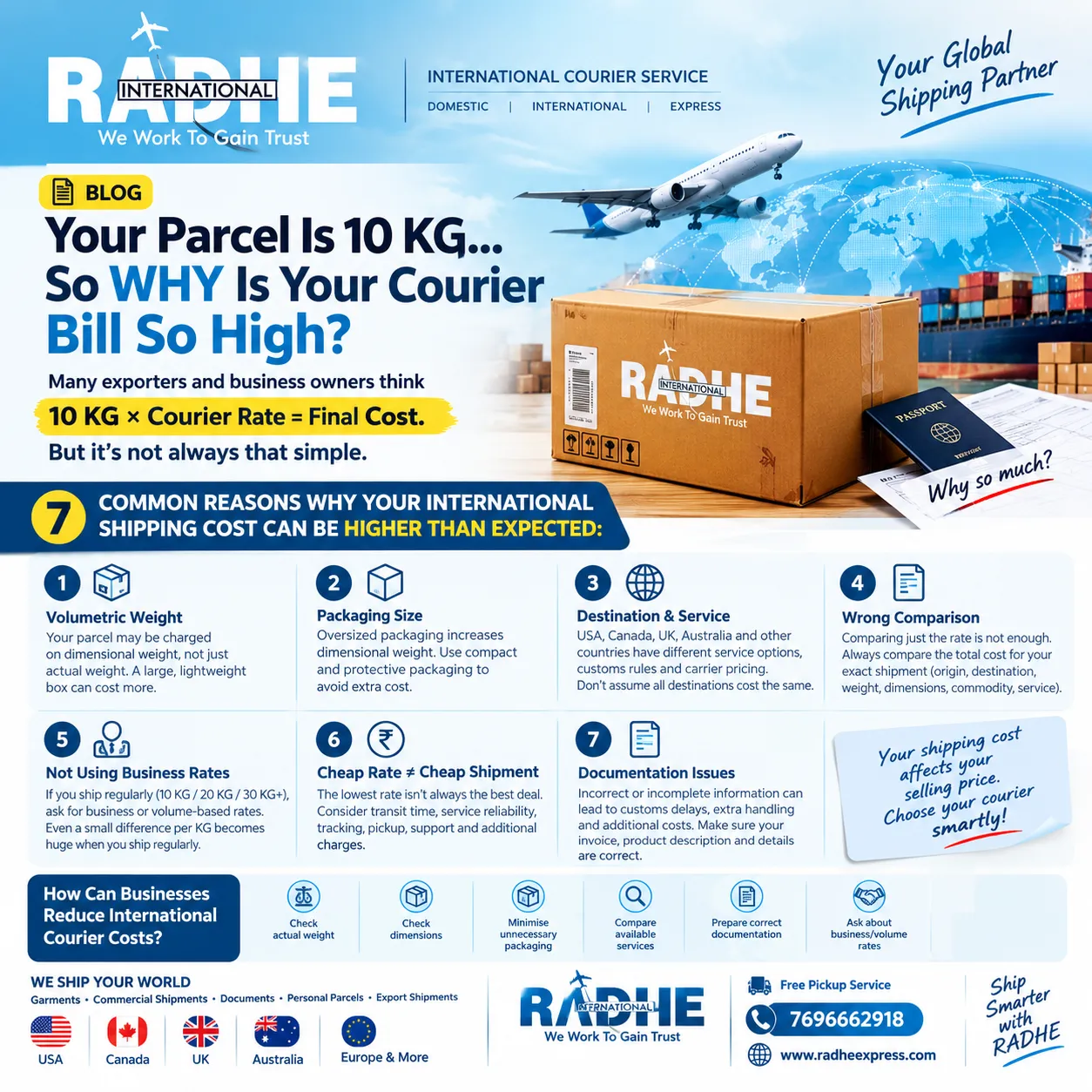
9. Understand Chargeable Weight
One common surprise for new international shippers is that courier charges may not always be based only on the physical weight of the parcel.
Depending on the courier and shipment, volumetric weight may also be considered.
That means a large but lightweight package can sometimes have a higher chargeable weight than expected.
This is why efficient packaging matters.
Better packaging can help protect the product and potentially reduce unnecessary shipping volume.
10. Compare International Courier Options
Choosing a courier partner is an important business decision.
Don't look only at the cheapest quoted number.
Compare:
- International shipping rates
- Destination coverage
- Tracking
- Pickup service
- Customs support
- Shipment handling
- Customer support
- Service options
- Experience with business shipments
For regular exporters, a reliable courier relationship can become an important part of the overall export process.
11. Start With Small Shipments
If you have never exported before, you don't necessarily need to begin with a huge shipment.
Start by understanding the process through smaller legitimate shipments.
This allows you to learn:
- Documentation
- Packaging
- Courier booking
- Tracking
- Customs procedures
- Customer communication
- Delivery experience
Once your process becomes comfortable, you can gradually increase your international business.
12. Keep Your Customer Informed
International customers want visibility after placing an order.
Provide shipment information and tracking details when available.
A professional shipping process should keep the customer informed about:
Shipment booked → Picked up → In transit → Customs processing → Out for delivery → Delivered
Clear communication can improve customer confidence and reduce unnecessary enquiries.
13. Calculate Your Total Export Cost
Don't calculate your selling price using only the product cost.
Your international selling price may need to consider several costs, such as:
- Product cost
- Packaging
- Courier/shipping
- Customs-related charges where applicable
- Taxes/duties where applicable
- Marketplace fees
- Payment processing
- Returns or replacement costs
- Other business expenses
Understanding your complete cost helps you avoid losing money on international orders.
14. Build a Reliable Shipping Process
Once you begin receiving regular international orders, create a simple repeatable process.
For every shipment:
Order received → Product checked → Packed → Documents prepared → Weight verified → Courier booked → Tracking shared → Delivery monitored
A consistent process reduces mistakes and makes it easier to handle increasing shipment volumes.
15. Grow Your International Business Step by Step
Exporting is not just about sending one parcel overseas.
The long-term goal is to build a reliable international business.
As your orders increase, you can improve:
- Packaging
- Product presentation
- Shipping rates
- Customer service
- Tracking systems
- Export documentation
- Inventory management
- International marketing
Small improvements can make a big difference as your shipment volume grows.
Why International Courier Matters for Small Exporters
For a small business, the courier partner is more than just a delivery company.
Your shipping experience can influence:
- Customer satisfaction
- Delivery expectations
- Product safety
- Business costs
- Repeat orders
- International reputation
That's why choosing a courier service that understands business shipments is important.
RADHE International Courier Service for Your Business
RADHE INTERNATIONAL COURIER SERVICE provides domestic and international courier solutions for businesses, exporters, manufacturers, retailers, boutiques and e-commerce sellers.
We help businesses send shipments internationally with competitive courier rates, free pickup service and professional shipment support.
Whether you are sending:
📦 Product samples
👗 Indian suits and garments
🏭 Manufactured products
🛍️ E-commerce orders
📄 Business documents
📦 Regular commercial shipments
RADHE can help you with your courier requirements.
We serve international shipping requirements to destinations including the USA, Canada, UK, Australia and more.
Ready to Take Your Business Global?
You don't have to wait until your business becomes large to start thinking internationally.
Start with the right product, understand your target market, prepare accurate documentation, pack properly and choose a reliable shipping partner.
Your business can go global. We can help you ship there.
📞 Call / WhatsApp: 7696662918
RADHE INTERNATIONAL COURIER SERVICE
We Work To Gain Trust.